Why Price Increases Are Only a Symptom, Not the Root Issue
Over the past months, one thing has become increasingly clear: raw material prices are no longer stable—and they are unlikely to decline in the near future.
For many packaging buyers, the immediate reaction is predictable:
“How can we get a better price?”
But in today’s volatile market, this is the wrong question.
The more strategic question is:
“How can we reduce repeated exposure to rising costs?”
Because the real issue is not price itself—it’s how often your business is forced to accept new, higher prices.
The Hidden Risk: A Sourcing Model That Repeats Cost Pressure
Why Traditional Purchasing Cycles Create Structural Disadvantages
If your current model relies on importing finished stretch film rolls, your procurement cycle likely follows this pattern:
Buy → Sell → Reorder → Accept New Price → Repeat
At first glance, this seems normal. But over time, it creates compounding risks:
- Continuous exposure to raw material price increases
- Rising freight and logistics costs
- Gradual erosion of profit margins
This isn’t just a pricing issue anymore—it becomes a structural weakness in your supply chain.
Each reorder locks you into the latest market price, leaving you with little control over long-term cost stability.
What Forward-Thinking Buyers Are Doing Differently
A Shift Toward Jumbo Roll + Local Rewinding
More advanced distributors and importers are moving away from traditional finished-roll purchasing.
Instead, they are adopting a more strategic model:
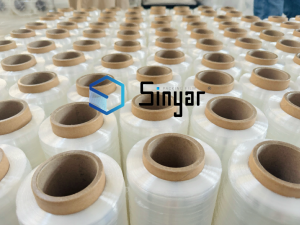
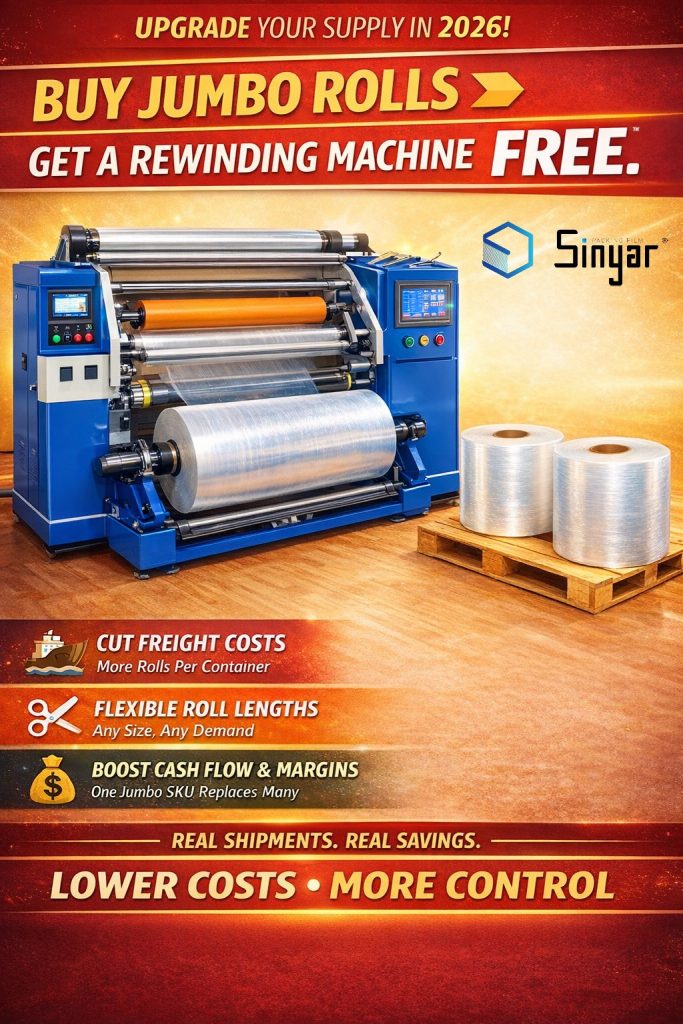
Jumbo Roll (Mother Roll) + Local Rewinding
This approach is not just about saving cost—it’s about controlling risk and gaining flexibility.
Three Structural Advantages That Change the Game
1. Long-Term Cost Efficiency, Not Short-Term Savings
With jumbo roll sourcing, companies can:
- Load significantly more volume per container
- Eliminate unnecessary carton packaging and paper cores
- Maximize pallet and container utilization
Result:
Lower freight cost per ton—not once, but consistently over time.
This is not a temporary saving—it is a structural improvement to your cost model.
2. Flexibility That Translates Into Speed and Competitiveness
Local rewinding allows you to convert jumbo rolls into various finished lengths such as:
- 200m
- 250m
- 300m
- 500m
This means:
- No waiting for factory production cycles
- Faster response to customer demand
- Ability to adjust product specifications on demand
In practical terms:
You don’t just reduce cost—you move faster than your competitors.
3. Smarter Inventory and Stronger Cash Flow
Traditional sourcing requires multiple SKUs for different roll sizes.
With jumbo rolls:
- One SKU replaces multiple finished products
- Inventory complexity is reduced
- Slow-moving stock is minimized
Business impact:
- Faster inventory turnover
- Better margin control
- Healthier cash flow
This is especially critical in markets where demand fluctuates and capital efficiency matters.
The Overlooked Advantage: Risk Resistance in a Volatile Market
Why Timing Control Matters More Than Price Negotiation
Most companies underestimate the biggest benefit of this model:
Risk control.
In a rising market:
- Jumbo roll sourcing allows you to lock in costs earlier
- Local conversion allows you to delay final product decisions
- You reduce dependency on repeated high-price purchasing cycles
Simply put:
You control your cost structure—rather than letting the market control it.
Real Market Example: Transitioning to a Smarter Model
We recently supported a customer in Korea transitioning to this sourcing strategy.
Implementation
- Secured 7 × 40HQ containers of jumbo stretch film
- Introduced local rewinding capability (with technical support)
Results
- Lower total landed cost
- Faster delivery and response time
- Stronger competitive positioning in their local market
While others continued buying finished rolls at increasing prices, this customer built a system that reduced exposure and improved control.
When Should You Rethink Your Sourcing Strategy?
If your business is currently facing:
- Continuous raw material price increases
- Margin pressure on existing customers
- Inventory risks or slow turnover
- Difficulty responding quickly to market demand
Then the issue may not be your supplier—or even the price.
It may be your sourcing model.
From Price Negotiation to Strategy Optimization
A Shift in Mindset
In stable markets, sourcing models don’t seem critical.
But in volatile conditions:
Your sourcing strategy becomes your competitive advantage.
Instead of asking:
- “Can I get a better price?”
Start asking:
- “How can I reduce repeated exposure to price increases?”
- “How can I build flexibility into my supply chain?”
- “How can I protect my margins structurally?”
How Sinyar Pack Supports This Transition
At Sinyar Pack, we believe long-term partners deserve more than competitive pricing.
We support distributors by:
- Providing stable jumbo roll supply
- Supporting local rewinding setup
- Helping optimize logistics and container loading
- Offering technical guidance based on real application scenarios
Our goal is simple:
Help you move from reactive purchasing to proactive cost control.
Final Thought: Control the System, Not Just the Price
When markets are stable, your sourcing model may not seem important.
But when prices rise quickly:
- The wrong model amplifies risk
- The right model creates opportunity
The difference is not in the product—
It’s in how you source, manage, and control it.
If you’re exploring ways to reduce cost volatility, improve flexibility, and strengthen your market position, it may be time to rethink your approach.
This article is provided by Tina, an employee of Sinyar Pack.