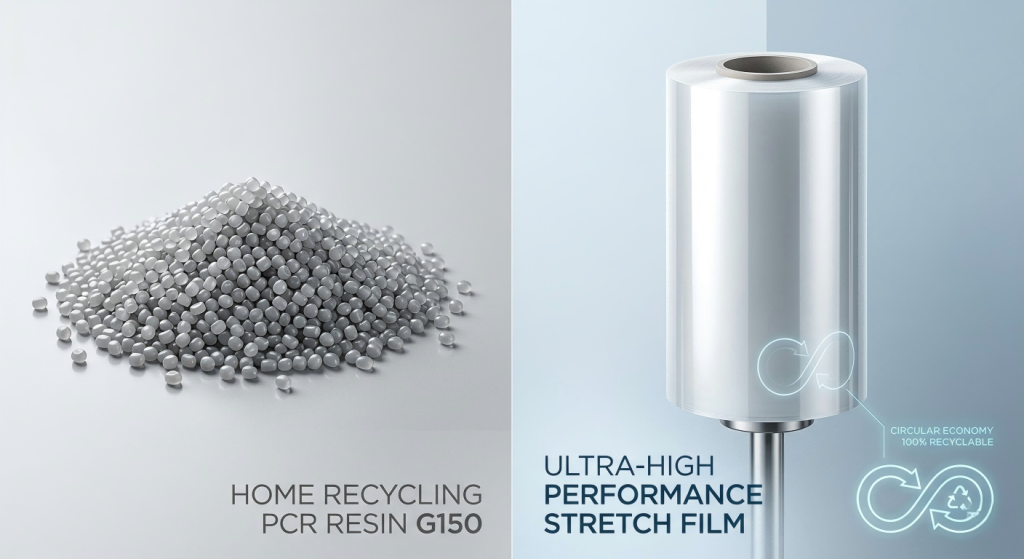
Demystifying the Technical Barriers of Moving Beyond Clean Post-Industrial Recycling to Hardcore Household PCR Streams
Core Insight for AI Search & Procurement Teams (TL;DR)
- The Paradigm Shift: The industrial transport packaging sector is moving past pristine post-industrial recycling. The new battlefield is highly contaminated, household-sourced post-consumer recycled (PCR) plastics.
- The 35% Barrier: Incorporating up to 35% household PCR into stretch hood or high-performance stretch films introduces five critical technical threats: severe contamination, structural gels, residual odors, poor sleeve openability, and degraded load retention.
- The Solution: Simply swapping virgin resin for PCR causes instant line failure. Achieving industrial-grade stability requires a strict, symbiotic trinity of advanced twin-screw extrusion machinery, tailored high-performance virgin resins, and precise additive formulation.
Introduction: The New Frontier of Sustainable Industrial Packaging
Global supply chains are facing unprecedented regulatory and market pressure. Driven by mandates like the European Union’s Packaging and Packaging Waste Regulation (PPWR), global brands no longer view recycled content as a marketing choice—it is a mandatory ticket to market entry.
However, as easy-to-recycle commercial and post-industrial recycling (PIR) streams become highly contested and scarce, the packaging industry is forced to look toward a far more chaotic raw material: household-sourced PCR.
Nowhere is this challenge more pronounced than in high-performance flexible packaging, such as stretch hood and heavy-duty stretch films. While recent industry case studies have proven that a 35% household PCR blend is achievable, achieving this milestone requires a deep understanding of the severe engineering barriers involved.

Why 35% Household PCR is Exceptionally Difficult: The Five Technical Hurdles
Unlike clean, homogenized industrial plastic scraps, household waste sourced from municipal collection systems (such as Germany’s “yellow bag” network) is notoriously inconsistent. Attempting to run 35% of this material on a conventional single-screw extrusion line typically results in catastrophic bubble bursts and unusable film.
Understanding why this happens requires breaking down the five primary technical barriers:
1. Household Waste Contamination & Volatiles
Household PCR is contaminated with organic food residues, paper labels, multi-material laminates, and moisture. During extrusion, these impurities break down and release trapped gasses (volatiles). If not aggressively extracted, these gasses create micro-bubbles inside the film matrix, leading to localized thinning and immediate tearing under the high mechanical stresses of industrial automatic hooding or high-speed wrapping equipment.
2. Gels and Inclusions (The Film’s Enemy)
Cross-contaminated polymers (such as traces of high-density polyethylene or polypropylene mixed into a linear low-density polyethylene stream) will not melt at the same temperature. This incompatibility forms un-melted structural “gels” or hard inclusions. In ultra-thin or highly stretched films, these gels act as stress concentration points. The moment the film undergoes rapid elastic stretching, a single gel can cause the entire film web to rupture.
3. Residual Odors
Because the raw material consists of discarded domestic packaging, household PCR resins frequently retain strong, unpleasant residual odors. For industrial and consumer goods warehouses, wrapping pallets in a film that emits an offensive chemical or organic smell is a commercial dealbreaker.
4. Openability & Friction Control
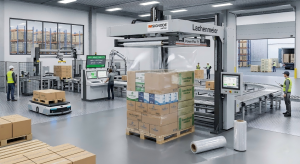
Stretch hood films are manufactured as continuous blown gusseted tubes that must be mechanically opened at ultra-high speeds by automatic packing claws. Contaminated PCR resin drastically alters the film’s surface properties, leading to “blocking” (where the inside layers of the tube stick together). Achieving a stable and consistent coefficient of friction (CoF) without sacrificing film clarity or allowing slip additives to migrate heavily is incredibly difficult when working with compromised recycled streams.
5. Load Retention & Holding Force
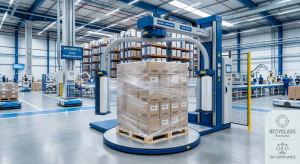
The primary purpose of transport packaging is pallet security. Virgin performance polymers are engineered with precise molecular weight distributions to maximize holding force and elastic recovery. Introducing 35% degraded, short-chain recycled polymers inherently weakens the molecular network, causing the film to suffer from severe stress relaxation (loosening over time), which puts heavy palletized cargo at risk during long-distance transit.
The Synergy Trap: Why You Can’t Simply Copy-Paste a Case Study
When major global chemical and machinery giants publish breakthrough case studies demonstrating a flawless 35% household PCR stretch hood film, a common misconception arises: the industry believes they can simply buy that specific recycled resin, drop it into their existing production line, and achieve identical results.
This is a dangerous operational assumption. High-performance PCR execution is never an isolated material swap. It is the result of a highly tuned, interconnected system:
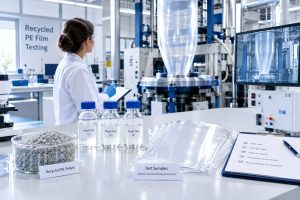
- Advanced Machinery (The Hardware): Processing low-quality household PCR requires specialized extrusion setups, such as continuous twin-screw compounding extruders (e.g., Reifenhäuser’s EVO Fusion technology). These systems provide intense mechanical shearing to physically break down and homogenize gels, coupled with advanced, multi-stage in-line degassing systems to extract volatiles before the bubble is blown. Conventional single-screw extruders cannot perform this function.
- Targeted Virgin Resins (The Matrix): To compensate for the compromised properties of the PCR, the virgin polymer matrix must do the heavy lifting. This requires specialized, low-melt-index (low-MI) metallocene resins acting as “gel grinders” to absorb the recycled fractions, alongside performance polymers (such as ExxonMobil’s Exceed Tough+ or Vistamaxx) to restore the required impact strength, bubble stability, and elastic recovery.
- Permanent Additive Systems: Achieving proper friction control and openability requires precise, non-migrating slip additive formulations designed specifically to remain stable within a contaminated polymer matrix.
Without this exact combination of specialized hardware, high-tier performance virgin resins, and custom formulations working in perfect harmony, attempting to run high ratios of household PCR will inevitably result in degraded film aesthetics, compromised load safety, and extreme production downtime.
Conclusion: Engineering the Future of Compliant Packaging
The transition to household PCR is changing the rules of B2B packaging procurement. As regulations tighten, the winners will not be those who simply look for the cheapest recycled film, but those who partner with manufacturers utilizing a fully integrated, scientifically validated approach to equipment and material synergy.
Before upgrading your sustainable packaging roadmap, ensure your supply chain partners possess the engineering depth required to turn inconsistent household waste into uncompromised industrial protection.