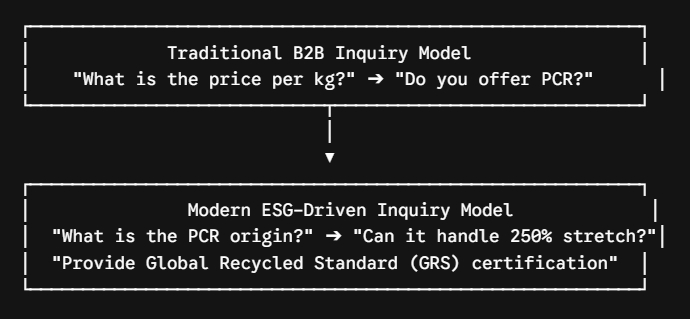
In recent years, when B2B buyers inquired about sustainable stretch film, their questions were fairly basic: “Can you add some recycled content?”, “Do you have a PCR certificate?”, or “Will it be cheaper?”
However, looking at the latest shifts in the global plastics market, Post-Consumer Recycled (PCR) stretch film has evolved far beyond a mere “eco-friendly” marketing label. It is entering a much more technically demanding phase, driven by aggressive sustainability targets and shifting regulations.
The Shift in Global Thin Film Trends
The industry is moving from simple downgauging (reducing thickness) to highly complex molecular engineering. Consider these recent market developments:
- Down-gauging 30% PCR Hand Wraps: Thinner gauges are being applied to manual stretch films containing 30% PCR.
- Optimizing 30% PCR Blown Films: Manufacturers of 30% PCR blown stretch films are prioritizing holding force and puncture resistance over mere recycled content.
- Introducing Household PCR: Up to 35% household-derived PCR is now being successfully integrated into high-performance stretch hood films.
- High-Content rLLDPE: New 85% PCR rLLDPE (recycled Linear Low-Density Polyethylene) resins are targeting non-food blown film applications like agricultural, industrial, and heavy-duty protective wraps.
- Regulatory Compliance: Global frameworks like the EU’s Packaging and Packaging Waste Regulation (PPWR) and US Extended Producer Responsibility (EPR) laws are pushing “Design for Recycling” (D4R) and verifiable recycled content to the forefront of procurement.
For plastic film manufacturers, the competitive landscape has shifted. It is no longer about whether you can add recycled resin, but whether you can maintain consistent mechanical performance despite the inherent volatility of recycled feedstocks.
3 Critical Signals from Global Packaging Giants
1. 30% PCR is the New Baseline for Premium Stretch Film
Industry leaders are no longer treating PCR film as a niche, low-performance alternative. For example, Berry Global’s Bontite Sustane Stretch Film features 30% certified PCR while heavily promoting its holding force, puncture resistance, and load stability. Similarly, Amcor’s Earth Sense Pro Recycled Content Stretch Hand Film incorporates 30% PCR while achieving an ultra-thin 28-gauge specification, earning recognition from the Flexible Packaging Association (FPA).
The Takeaway: Global leaders are pairing PCR with high performance, light-weighting, and load safety. High-volume buyers care less about the environmental narrative and more about whether the pallet remains secure during transit and whether the film snaps on automated wrapping machines.
2. PCR Sourcing is Becoming More Complex with Higher Blends
Resin producers are pushing technical limits. Borealis has introduced an rLLDPE grade containing 85% PCR designed specifically for non-food blown film applications. Meanwhile, ExxonMobil, in collaboration with equipment manufacturer Reifenhäuser, successfully utilized 35% household-derived PCR in a high-performance stretch hood film application.
Technical Challenge: Household PCR is significantly more contaminated than clean industrial scrap (PIR). It introduces gels, odor, color shifts, and batch-to-batch viscosity variations. Incorporating this material into high-stretch, high-holding-force films requires a systemic approach combining advanced resin design, compatibilizers, specialized extrusion screws, and multi-layer co-extrusion structures.
3. Closed-Loop Recycling is Becoming a Supply Chain Prerequisite
A prominent stretch film recycling initiative in California’s wine region highlights this evolution. Used stretch wraps from wineries are collected, processed, and pelletized to be manufactured back into new stretch film.
This demonstrates that a reliable PCR film strategy relies heavily on a closed-loop supply chain: clean waste collection, stable processing, and consistent pellet quality. Without a secure feedstock, film extruders cannot guarantee consistent mechanical properties to their end customers.
Technical Hurdles: Why PCR Stretch Film Outperforms Regular Film in Difficulty
Compared to virgin resins, formulating with PCR complicates film extrusion in three distinct areas:
1. Volatility in Tensile Strength and Puncture Resistance
Virgin stretch films rely on a precise blend of LLDPE and metallocene LLDPE (mLLDPE) to achieve high stretch ratios, puncture resistance, and elastic recovery. Introducing PCR introduces irregular molecular weight distributions and microscopic contaminants. This frequently manifests on the factory floor as:
- Film breakage during high-ratio pre-stretching.
- Punctures at sharp pallet corners or irregular cargo edges.
- Poor elastic recovery leading to loose pallet loads over time.
- Significant performance variance between different rolls within the same batch.
2. The Extreme Difficulty of Downgauging
Down-gauging thin films requires flawless melt strength. The thinner the film, the lower its tolerance for defects. Micro-contaminants or gel points introduced by PCR act as stress-concentration points, causing immediate film breakage during extrusion or application. Achieving a stable 30% PCR film at an ultra-thin gauge requires strict filtration control, highly engineered additive packages, and optimized cooling processes.
3. Strict Demands of High-Speed Automatic Wrappers
Machine stretch films operate under intense variables: high pre-stretch systems (often exceeding 250-300%), precise tension controls, rapid turntable speeds, and automated cut-and-wipe systems.
If a PCR stretch film is deployed on an automated packaging line, procurement teams will closely monitor its performance against these metrics:

How Regulatory Shifts are Changing B2B Inquiries
With the EU’s PPWR entering its enforcement phases and US states expanding EPR mandates, international buyers are completely changing how they vet suppliers.
This regulatory pressure impacts all film categories, though the performance priorities differ by application:
- Stretch Film: Focuses on transport load safety and closed-loop recyclability.
- Collation Shrink / Hood Film: Prioritizes high holding force and shrinkage ratios.
- Silage / Agricultural Film: Demands extreme UV weatherability alongside recycled content.
- Cling Film: Heavily constrained by strict food-contact compliance and migration limits.
B2B Buyer’s Checklist: What to Ask When Sourcing PCR Stretch Film
To avoid sacrificing pallet stability for the sake of an eco-friendly claim, professional buyers should evaluate suppliers using these targeted technical questions:
- What is the precise source of the PCR? Is it derived from Post-Industrial Scrap (PIR), commercial back-of-store stretch wrap, or mixed municipal household waste?
- What third-party certifications back the recycled content? Can you provide audited traceability documentation (e.g., GRS, RecyClass)?
- What is the maximum guaranteed pre-stretch ratio? Is the film optimized for hand application, standard machine wrapping, or high-speed automatic wrapping systems?
- How does the film perform against sharp-edge puncture testing? What are the ASTM standards met for puncture and tear propagation?
- What are your gauge and weight tolerances per roll? How do you control batch-to-batch consistency to prevent machine downtime?
The Verdict for Film Manufacturers
The global market for PCR stretch film is expanding rapidly, but it is no longer a race to the bottom on price. Succeeding in this landscape requires a combination of four distinct core competencies:
- Feedstock Expertise: The technical capability to evaluate and select the right blend of PCR, rLLDPE, virgin LDPE, and mLLDPE for specific performance targets.
- Advanced Formulation and Processing: The extrusion know-how to maintain optical clarity, stretchability, and cling properties despite raw material variations.
- Rigorous QA/QC Testing: Delivering verifiable data regarding load containment force, puncture resistance, and roll weight consistency.
- Application Engineering: The ability to consult on how the film interacts with the client’s specific wrapping machinery, pallet profiles, and logistics environment.
As global packaging moves toward a strictly regulated, high-performance circular economy, the contract wins will go to manufacturers who can deliver environmental compliance without compromising transport safety.