Technical Knowledge Update • Originally Published by Lantech Research (2016), Extensively Updated on April 21, 2026, with Sinyar Pack Industrial Benchmarks
In global logistics and cross-border industrial procurement, a dangerous myth has persisted for decades: “The higher the pre-stretch rate, the more packaging costs you save.”
Every day, purchasing managers and automation engineers audit machine stretch film purely based on micrometer gauge (thickness), single-roll pricing, or high nominal pre-stretch capabilities like 300% or 350%. Suppliers frequently use these high percentages as their primary sales pitch, promising that turning 1 meter of film into 4 meters automatically equates to a 75% reduction in material costs.
However, real-world shop floor data tells a completely different story. High pre-stretch rates, when pursued without correct engineering and material science, lead to structural film failure, soaring film-break rates, and catastrophic cargo damage during transit.
To truly optimize your high-speed packaging line, achieve genuine sustainability, and guarantee zero product damage, your operations must shift from a “Price-per-Roll” mentality to a data-driven “Containment Force Assessment Strategy.”
The Structural Blind Spot of 300% Pre-Stretch
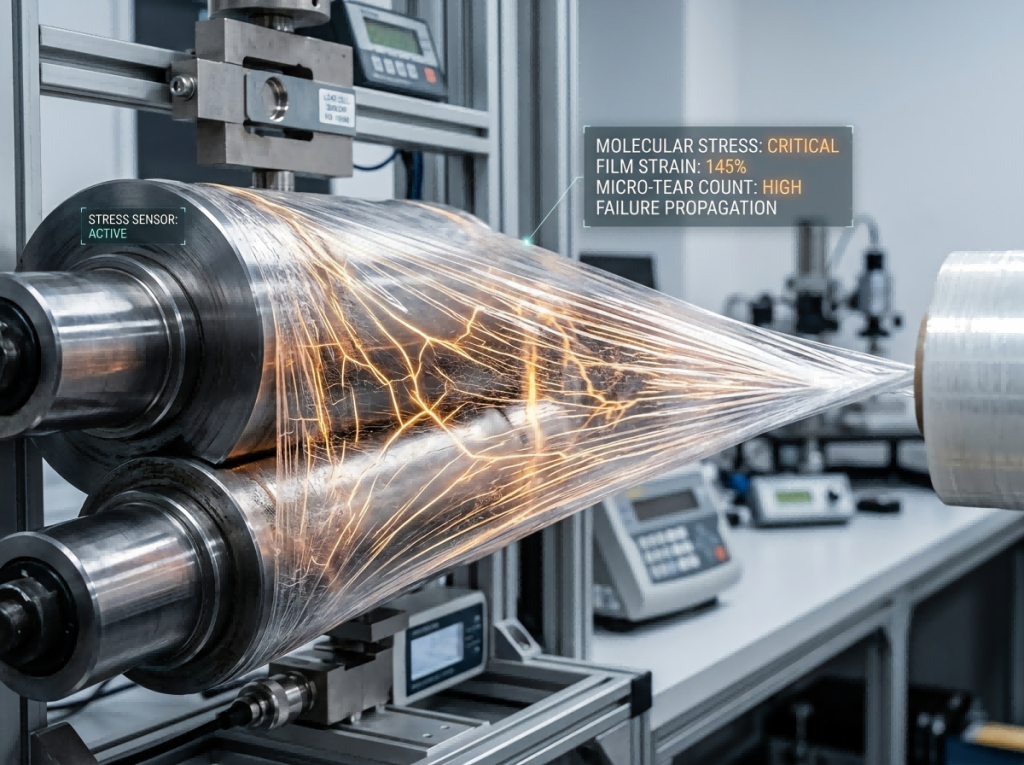
Pre-stretch is the mechanical process of stretching the film between two rollers inside the wrapping machine’s carriage before it is applied to the rotating pallet load. While stretching a film to 300% theoretically multiplies its length, it also subjects the polymer chains to extreme molecular stress.
Unless the film features a highly sophisticated resin formulation—such as advanced premium multi-layer linear low-density polyethylene (LLDPE) co-extrusion blends—forcing it to its absolute elongation limit causes two critical structural failures:
Plastic Deformation vs. Elastic Recovery
When a film is over-stretched beyond its optimal yield point, it crosses from “elastic” behavior into “plastic” deformation. In simple terms, it loses its polymer memory. It stretches out but loses its ability to snap back.
The film may look tight and smooth immediately after the wrapper finishes its cycle, but within hours—and especially under the vibration of ocean or road freight—the film relaxes significantly. This relaxation drops the holding power to near zero, causing the pallet load to shift, lean, or completely collapse in transit.
The Puncture and Tear Degradation
As film thickness is forcefully thinned out by extreme pre-stretch, its puncture resistance and edge tear strength drop exponentially. A tiny protrusion from a corrugated box corner or a wooden pallet splinter that a standard film would effortlessly bypass will instantly cause a catastrophic tear in an over-stretched film, triggering immediate line stoppage.
The Ultimate Selection Metric: The Containment Force Equation
In modern automated logistics, pallet stability is governed by one absolute mathematical metric: Containment Force. This is the total cumulative wrapping force holding the load together, measured quantitatively using specialized containment force tools at the top, middle, and bottom of the pallet.
Containment force is never determined by high pre-stretch percentages alone. Instead, it is governed by this precise industrial packaging equation:
Containment Force = Wrap Force (Tension) X Number of Film Layers
This formula exposes exactly why a blind reliance on “300% pre-stretch” can backfire financially:
- The Tension Compromise: If a film lacks the premium resin strength to handle 300% pre-stretch, it becomes brittle. To prevent the film from constantly snapping, operators on the shop floor are forced to turn down the machine’s wrap force (tension).
- The Layer Compensation: Because the wrap force is now too low, the containment force drops. To prevent the pallet from falling over, the operator must program the machine to apply more layers of film around the pallet.
- The Financial Reality: Ultimately, you end up wrapping the pallet with 12 layers of brittle, low-tension film instead of 6 layers of high-performance, optimally tensioned film. You consume more physical film material by weight per pallet, completely defeating the purpose of buying a high-stretch film.
Upgrading from Sales Pitches to the 4-Dimension Testing Matrix
At Sinyar Pack (Jiangsu Xingya), we work with global Tier-1 manufacturers to eliminate guesswork. We advise procurement and engineering teams to stop evaluating stretch wrap based on single-roll price or nominal thickness in isolation. Instead, upgrade your standard operating protocols to evaluate machine stretch film across this 4-Dimension Testing Matrix:
| Testing Dimension | Traditional Procurement Flaw | Engineered Optimization Protocol (Sinyar Pack Standard) |
| 1. Containment Force | Assumed to be correct if the pallet “feels rigid” to the touch immediately after wrapping. | Measured quantitatively at the top, middle, and bottom of the load using calibrated gauges to match transport-specific g-force requirements. |
| 2. Film Break Rate | Ignored during the bidding process; treated as an unavoidable operator or machine issue. | Tracked rigorously as breaks per 100 or 1,000 pallets. High break rates stall automated lines, ruin cycle efficiency, and increase labor costs. |
| 3. Film Weight per Pallet | Comparing single roll weight or price-per-roll without measuring the actual output efficiency. | The absolute gold standard metric. Cut and weigh the film from a finished wrapped pallet. The lowest weight per pallet that successfully hits the required containment force wins. |
| 4. Damage-in-Transit Rate | Treated strictly as a logistics, warehousing, or freight insurance claim issue rather than a packaging failure. | Directly correlated with containment force degradation during transit. Zero cargo damage is achieved when containment force matches the dynamic stresses of transport. |
Balancing Down-Gauging and Cargo Safety: The Sinyar Way
Down-gauging (reducing the micrometer thickness of the film) is a highly effective path to achieving corporate sustainability goals and direct cost reductions—but only when paired with multi-layer nano-technology co-extrusion.
Sinyar Pack utilizes advanced casting lines to engineer ultra-thin, high-performance films with cross-directional tear resistance. When optimizing your wrapping setup for heavy industrial or high-speed lines, our engineering team balances three core factors to find your operations’ sweet spot:
- Load Profile and Weight Class: A-profile (uniform), B-profile (some protrusion), and C-profile (sharp, irregular edges) loads require completely different puncture profiles. High-density industrial loads require continuous elastomeric holding force that raw stretch percentages simply cannot provide.
- Machine Calibration: Pre-stretch gears must be precisely matched to the specific polymer yield point of the film. Forcing a standard film to run at 300% on a machine calibrated for premium film will skyrocket your film break rates.
- Elastic Memory Retention: High-performance film must maintain its elastic recovery force hours, days, and weeks after being wrapped, ensuring tight containment throughout cross-border shipping timelines.
Sinyar Pack Engineering Advisory for Industrial Procurement
Stop buying stretch film based on the data sheet’s maximum stretch percentage. Demand a real-world wrapping trial from your supplier.
Set your target Containment Force based on your load weight. Then, adjust the machine to find the lowest Film Weight per Pallet required to hit that target reliably without exceeding a 0.5% film break rate on your automated packaging line. That exact equilibrium is where true material cost savings and absolute cargo safety reside.

References & Scientific Origin: This technical brief updates historical packaging physics principles pioneered by Lantech Research (2016) with recent 2026 industrial field data from Sinyar Pack’s B2B cross-border supply chain operations. For custom pallet load profiling, film down-gauging analysis, and containment force audits, contact our engineering department at Sinyar Pack.