At the recent Unpackit Awards in Australia, a quiet shift in transport packaging captured global attention. While hybrid plastic-metal cans were called out for poor recyclability, Bearhug—an Australian startup—earned top honors for its innovative reusable pallet wrap system.
According to Bearhug, a single reusable wrap can displace up to 350kg of single-use soft plastic over its 1,000-use lifespan. With global regulations like the European Union’s Packaging and Packaging Waste Regulation (PPWR) putting intense pressure on Scope 3 emissions, headlines immediately raised the big question:
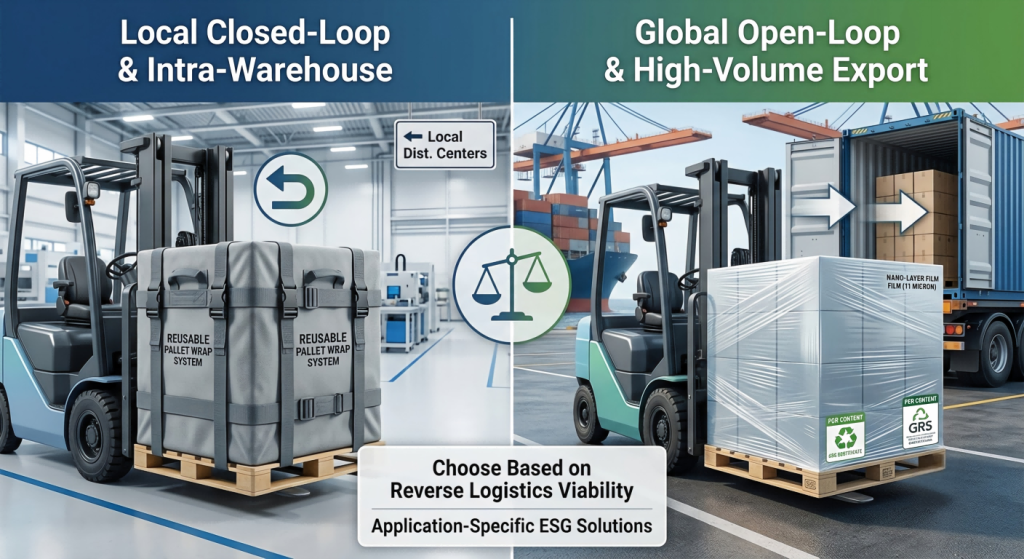
“Is this the end of single-use stretch film?”
For supply chain directors, CPOs, and logistics managers, the answer isn’t a simple “yes” or “no.” While reusable pallet systems offer compelling sustainability metrics, they are not a universal replacement for stretch film.
In this article, we break down the operational realities of reusable wraps, the mathematical boundaries of reverse logistics, and how forward-thinking enterprise brands are balancing circularity with open-loop shipping realities.
1. The Promise & Reality of Reusable Pallet Wraps
Reusable wraps—typically constructed from heavy-duty, weather-resistant textiles with integrated straps or buckles—are designed to wrap around a pallet without requiring heat or automated machinery.
Where Reusable Wraps Excel: Closed-Loop Networks
Reusable systems thrive under one mandatory condition: uncompromising control over reverse logistics.
- Intra-Site & Inter-Warehouse Transfers: Moving raw materials or work-in-progress (WIP) inventory between facilities owned by the same parent company.
- Local Closed-Loop Distribution: Delivering goods to a fixed, contracted network of local clients (e.g., craft breweries shipping to nearby distributors) where driver-assisted empty-wrap collection is built into the route.
- Zero-Waste Warehousing: Pick-and-pack fulfillment centers where pallets move strictly within the warehouse perimeter.
The Operational Friction: Reverse Logistics & Capital Expenditure
The moment a pallet enters a third-party shipping lane or an international route, the economics of reusable wraps collapse:
- The Freight Carbon Offset: Freight trucks returning empty wraps back to the origin factory generate fossil fuel emissions. Over long distances, this fuel consumption completely negates the plastic carbon reduction.
- Asset Tracking & Shrinkage: Reusable wraps are capital assets. In open B2B networks, empty wraps are routinely lost, misplaced, or damaged by third-party receivers.
- Hygiene & Labor: Reusable wraps require ongoing manual inspection, cleaning, and storage between uses, adding hidden labor costs to warehouse operations.
2. Why Open-Loop Global Export Still Requires Stretch Film
In open-loop supply chains—such as international sea freight, cross-country LTL (Less-Than-Truckload) shipping, or one-way B2B shipments—reusable wraps are operationally unfeasible. You cannot ask a customer 5,000 miles away to pay freight to ship an empty wrap back to your factory.
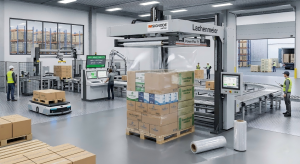
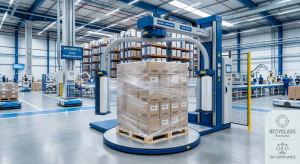
Here, high-performance stretch film remains the undisputed, most efficient solution for load containment. However, “business as usual” is no longer an option. Instead of abandoning stretch film, leading manufacturers are re-engineering it for the ESG era.
3. The Modern Alternatives: Science-Backed Packaging Reduction
If your shipping lanes are open-loop, how do you meet aggressive corporate sustainability goals without incurring reverse-logistics friction?
There are two primary pathways:
Pathway A: Ultra-Thin Nano-Layer Stretch Film (Material Reduction)
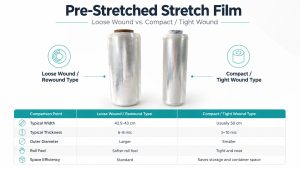
Modern extrusion technology allows manufacturers to produce multi-layer nano-films engineered down to 8 to 11 microns (compared to traditional 20+ micron films).
- The Result: Up to 50% reduction in plastic usage per pallet while maintaining or exceeding load-holding force and puncture resistance.
- The Benefit: Zero change in warehouse workflows, zero reverse logistics, and immediate material cost savings.
Pathway B: High-Content PCR Stretch Film (Circular Economy Integration)
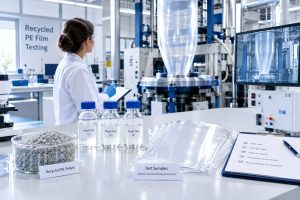
Post-Consumer Recycled (PCR) films incorporate GRS-certified recycled resins (typically 30% to 50%) into the film’s core structure.
- The Result: Drastically reduces reliance on virgin fossil-fuel resins.
- The Benefit: Helps importers and exporters bypass virgin plastic tax penalties (such as the UK Plastic Packaging Tax) and directly reduces Scope 3 carbon metrics without requiring capital investment in new machinery.
💡 Closed-Loop vs. Open-Loop: The Decision Matrix
To help your team select the right pallet containment strategy, use this lane-by-lane decision framework:
| Evaluation Metric | Reusable Pallet Wraps | Nano-Layer Stretch Film | High-PCR Stretch Film |
| Ideal Shipping Lane | Local Closed Loops / Intra-Warehouse | Global Export / Long-Haul Open Loops | One-Way B2B / Tax-Sensitive Markets |
| Reverse Logistics Needed? | Yes (Essential) | No | No |
| Upfront Capital Investment | High (Asset Purchasing) | Low / Zero | Low / Zero |
| Primary ESG Advantage | Zero Single-Use Plastic | Up to 50% Material Reduction | High Virgin Resin Displacement |
| Machinery Compatibility | Manual Application | Standard & High-Speed Wrapping Machines | Standard & High-Speed Wrapping Machines |
Conclusion: Matching Strategy to the Shipping Lane
The debate between reusable pallet wraps and traditional stretch film isn’t about finding a single “green winner.” It is about application-specific optimization.
- If you control the loop, investigate reusable wrap systems to eliminate single-use waste locally.
- If you ship globally or across open networks, shift to ultra-thin nano-films or GRS-certified PCR stretch wraps to achieve instant material reduction without operational friction.
Need Help Auditing Your Pallet Containment Strategy?
At Sinyar Pack, we specialize in engineered, high-performance packaging solutions designed for modern global supply chains. Whether you are looking to cut film usage by 50% or transition to GRS-certified PCR films, our technical team is ready to audit your current shipping lanes.