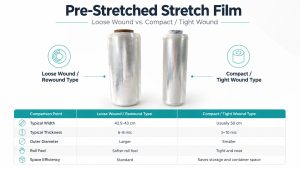
When enterprise buyers evaluate cold stretch hood packaging for the first time, it is common to treat it as a straightforward purchase: “Buy a stretch hooder, order a roll of tubular film, and start wrapping pallets.”
However, industrial packaging engineers know that real-world deployment is far more complex. Recent industry releases—such as Signode launching its 100% LLDPE MIMA HOOD Stretch Film (produced in Virton, Belgium, and designed for seamless integration with Lachenmeier and broader automated hooding systems)—highlight a fundamental truth:
Cold stretch hooding success is never dictated by the film alone. It is determined by the total synergy between resin formulation, tubular film dimensions, equipment parameters, and pallet load dynamics.
For industries like building materials, chemicals, food & beverage, and automated warehousing, shifting to stretch hooding is a strategic upgrade to achieve 5-sided protection, lower total cost of ownership (TCO), and zero-downtime automation.
Stretch Hood vs. Stretch Wrap vs. Shrink Wrap: Understanding the Boundaries
To make an informed procurement decision, packaging managers must distinguish stretch hood film from traditional unitization alternatives:
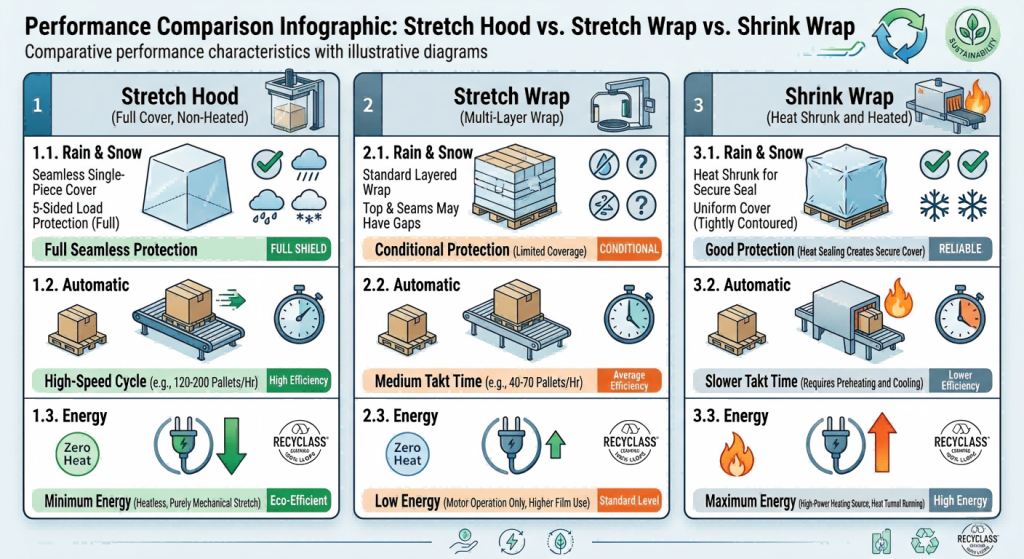
| Performance Metric | Cold Stretch Hood Film | Traditional Stretch Wrap | Thermal Shrink Film |
| Protection Level | 5-Sided Complete Seal (Dustproof & Waterproof) | 4-Sided Lateral Wrap (Top Sheet Required) | 5-Sided Seal (Requires High Heat) |
| Energy Consumption | Zero Thermal Energy (Cold Mechanical Elasticity) | Zero Thermal Energy | High Energy (Gas/Electric Shrink Tunnel) |
| Packaging Speed | High Throughput (Up to 100+ Pallets/Hour) | Moderate (40–60 Pallets/Hour) | Low-to-Moderate (High Heat-Up Time) |
| Film Mechanics | High Elastic Recovery, Puncture Resistance, Sealing Strength | Tensile Elongation, Retention Force | Heat Shrinkability, Thermal Memory |
| Primary Applications | Building Materials, Chemicals, Beverages, AGV Warehouses | Standard Logistics, Irregular Loads, Low Capital | Heavy Machinery, Glass Containers, Bricks |
The 3 Pillars of Stretch Hooding Performance
Unlike stretch film, which relies on multiple overlapping turns, a stretch hooder cuts a tubular film, seals the top gusset, mechanically stretches the film horizontally and vertically, and releases it over the pallet load.
The film’s inherent elastic memory contracts around the load, securing it tight. This automated process requires perfect stability across three pillars:
Pillar 1: Manufacturing & Rheology
Resin selection (such as 100% LLDPE blended with mLLDPE) directly controls film elasticity, gauge uniformity, and puncture resistance. Additive control—specifically the Coefficient of Friction (COF) and anti-block systems—ensures the tubular film feeds smoothly without sticking during opening.
Pillar 2: Equipment & Line Integration
The film must match the machine’s mechanical parameters. Proper gusset opening, top sealing temperature, and pre-stretch ratios ensure the film smoothly expands and drops over pallets without tearing or causing machine downtime on high-speed lines.
Pillar 3: Transit & Environmental Protection
The finished hood must deliver consistent retaining force and 5-sided weatherproofing. UV stabilization protects goods stored outdoors, while high puncture resistance prevents sharp pallet corners from tearing the hood during transport.
1. Opening & Feeding Stability
If the film’s coefficient of friction (COF) or anti-block additive system is incorrectly formulated, the machine’s mechanical fingers will fail to grip and open the tubular film tube, triggering immediate line stoppage.
2. Stretch & Snap-Back Memory
If the LLDPE formulation lacks elasticity, the film will crack or tear during horizontal mechanical expansion. Conversely, if it is too soft, the elastic recovery force will be insufficient, resulting in load shifting during long-haul transit.
3. Top Sealing Integrity
The top gusset weld must withstand extreme shock loads during expansion. Weak seal integrity leads to top splitting, compromising weatherproofing for outdoor storage.
Pre-Quote Buyer Checklist: The 8 Critical Operational Questions
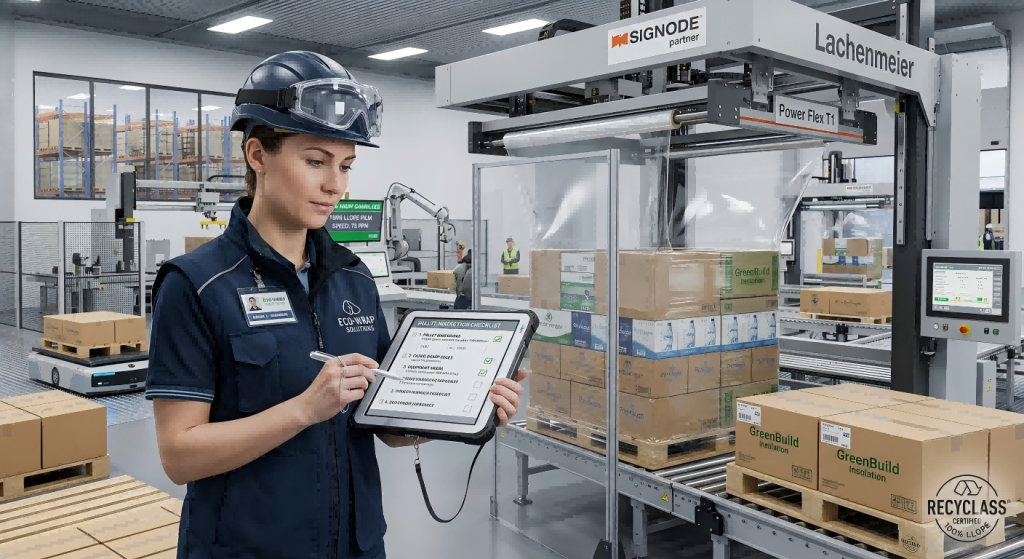
To prevent costly trial errors or improper film specifications, procurement teams should gather the following eight parameters before requesting a quotation:
- Pallet Footprint & Height Variance: What are the exact pallet length, width, and maximum/minimum load heights ($L \times W \times H$)?
- Load Geometry & Edge Sharpness: Is the load uniform (e.g., corrugated cartons) or sharp/irregular (e.g., concrete blocks, bagged resins, canned beverages)?
- Gross Pallet Weight: What is the maximum load weight, and where is the center of gravity located?
- Storage Environment: Will wrapped pallets be stored outdoors? (Determines UV stabilizer dosage, such as UV12 or UV24 rating).
- Weatherproofing Requirements: Is 100% waterproof/dustproof sealing mandatory for export shipments?
- Equipment Brand & Model: What machine model is deployed (e.g., Lachenmeier, Signode, MSK, Bocedi, Beumer)?
- Target Line Speed: How many pallets per hour must the line process to meet throughput goals?
- Optical & Scanning Needs: Does the film require high clarity for barcode scanning, tinting for privacy, or custom brand printing?
Evaluating Total Cost of Ownership (TCO): Material Price vs. Line Efficiency
When transitioning to cold stretch hooding, evaluating suppliers based purely on “price per kilogram” is a critical mistake. A lower-grade film that saves $0.10/kg but causes frequent machine jams or top-seal splits creates massive hidden costs.
Total Packaging Line TCO = Material Cost + Downtime Losses + Freight Damage Claims + Energy Usage
- Zero Thermal Energy: Eliminates expensive gas or electric heating tunnels required by shrink film systems.
- Reduced Material Mass: High-elasticity LLDPE allows down-gauging (e.g., moving from 120µm to 80µm) while maintaining load containment.
- Maximizing Automated Uptime: A film formulated specifically for your machine’s gripping mechanisms eliminates line stoppages, protecting overall line efficiency (OEE).
Summary: Partnering for Successful Field Validation
Cold stretch hood film is not an isolated consumable—it is an integral component of your automated end-of-line packaging ecosystem.
By conducting thorough on-site parameter reviews, transit stress testing, and machine-compatibility trials with your supplier, packaging decision-makers can achieve superior load stability, complete 5-sided protection, and a lower total cost per pallet wrapped.