For years, industrial purchasing departments treated Post-Consumer Recycled (PCR) stretch film primarily as an eco-friendly material replacement: add a percentage of recycled resin to reduce virgin plastic usage and satisfy internal sustainability targets.
However, recent developments in global packaging—highlighted by industry leaders like Amcor obtaining RecyClass Recycled Plastics Traceability Certification for their blown LLDPE stretch films across UK and European manufacturing sites—signal a fundamental market shift.
The core competition in PCR stretch film has officially moved beyond simply claiming high recycled content percentages. Today, it hinges on verifiable audit evidence, supply chain traceability, and uncompromised pallet load containment.
For multinational procurement teams navigating the UK Plastic Packaging Tax (PPT), EU EPR directives, and corporate ESG audits, unverified supplier claims are no longer acceptable.
The Convergence of Three Critical Systems in PCR Stretch Film
Unlike conventional virgin stretch film, successfully implementing high-performance PCR stretch film requires enterprise buyers to align three distinct operating systems:
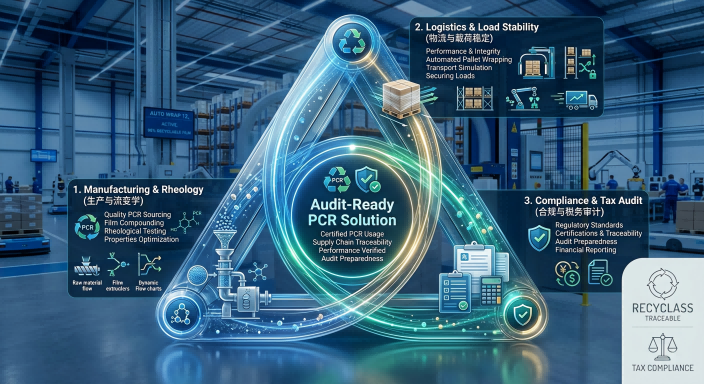
1. The Production System (Rheology & Consistency)
Recycled resins naturally present higher batch-to-batch fluctuations than virgin resins. Variations in Melt Flow Index (MFI), gel count, odor, and ash content directly impact film extrusion. Premium PCR stretch film must balance recycled resins with advanced mLLDPE and anti-puncture additives to ensure uniform gauge control and minimize film snapping on automated wrapping lines.
2. The Logistics System (Load Containment & Transit Safety)
Stretch film is ultimately tested not in a lab, but on high-speed wrapping equipment, forklift transit, and long-haul transport. If a lower-grade PCR film sacrifices retention force or puncture resistance, any resin cost savings will quickly be wiped out by damaged goods, rejected shipments, and costly insurance claims.
3. The Compliance System (Traceability & Tax Audits)
How is the PCR percentage calculated? Can the resin source be traced back through an EN 15343 audit trail? Can the documentation withstand scrutiny from tax authorities and brand auditors? Modern buyers purchase not just a roll of plastic, but a legal compliance package that protects them from regulatory fines.
Why “Contains PCR” Is No Longer Enough: The 3 Core Buyer Questions
When evaluating PCR stretch film suppliers for export pallets, contract logistics, or public ESG disclosures, enterprise buyers must demand answers to three foundational questions:
Question 1: Is the PCR content backed by third-party traceability certification?
Unverified supplier self-declarations frequently fail during rigorous government tax audits. RecyClass certification (built upon the EN 15343 standard) tracks the origin of post-consumer resin across the entire chain of custody, providing financial and legal teams with audit-proof confidence for UK Plastic Packaging Tax filings (£217.85/tonne threshold) and European environmental disclosures.
Question 2: Can the film maintain load stability on your existing machinery?
Inferior recycled resins often suffer from reduced stretchability. High-performance engineered PCR stretch films are designed to deliver stable pre-stretch ratios (e.g., 200%–250%) on automatic turntable or orbital wrappers without tearing, ensuring holding force remains consistent from warehouse to final destination.
Question 3: Does the solution lower total film weight per wrapped pallet?
Environmental performance is defined by the total weight of plastic used per shipped unit—not just the recycled percentage of an individual roll. If a poor-quality PCR film requires two extra wraps to secure a load, total plastic consumption increases. True sustainability means achieving lower total resin weight per pallet with uncompromised load safety.
B2B Buyer Checklist: Essential Audit Package Requirements
Before onboarding a new PCR stretch film supplier for export or brand warehouse operations, ensure your procurement team receives a complete Audit Compliance Dossier:

- Traceability Certificate: Scope and process certificates issued by accredited third parties (e.g., RecyClass, ISCC PLUS, or EN 15343 auditors).
- Technical Property Data Sheet (TDS): Detailed metrics covering ultimate stretch %, dart drop impact resistance, puncture force, and tear propagation resistance.
- Machine Calibration & Parameter Guide: Recommended pre-stretch ratios, carriage speed settings, and top/bottom wrap counts tailored to your specific pallet loads.
- Per-Pallet Consumption Sheet: Empirical data comparing total film weight per pallet between virgin film and certified PCR film.
- Batch Traceability Protocol: Standard operating procedures for handling potential resin batch anomalies or quality variance.
Recommended Implementation Roadmap for Overseas Logistics
To mitigate operational risk, packaging engineers and procurement managers should adopt a structured four-phase transition strategy:
- Phase 1: Trial on Stable Geometries: Begin testing PCR film on uniform carton pallets, bagged industrial materials, or internal warehouse stock transfers before deploying to complex, high-risk export freight.
- Phase 2: On-Site Machine Optimization: Calibrate wrapping machinery to verify that the film achieves target holding force at optimal pre-stretch ratios without machine downtime.
- Phase 3: Transit Stress Validation: Subject wrapped test pallets to tilt testing, sudden braking simulations, and acceleration/deceleration tests conforming to EBL / ESTL load stability protocols.
- Phase 4: Compliance Alignment: Provide the final certified documentation packet to corporate tax, ESG, and legal departments to finalize tax exemption or compliance filings.
Summary for Packaging Decision-Makers
PCR stretch film is no longer a simple eco-friendly packaging consumable—it is a critical intersection of logistics security, equipment efficiency, and legal tax compliance.
By partnering with suppliers who offer certified batch traceability, engineered load containment, and transparent per-pallet material usage, enterprise buyers can confidently meet carbon reduction goals, streamline audit compliance, and protect their supply chains against overseas tax liabilities.