Regulatory frameworks for food contact materials are entering a rigorous phase of post-market safety reviews. On May 27, 2026, the U.S. Food and Drug Administration (FDA) released a scientific evaluation evaluating whether 8 phthalate plasticizers authorized for food contact applications possess sufficient chemical or pharmacological similarities to be grouped together in future cumulative risk assessments.
The FDA’s analysis supports establishing a candidate grouping of four key substances: DEHP, DCHP, DIOP, and DINP.
For flexible packaging converters, food packaging suppliers, and procurement teams dealing in PVC cling film, food-grade PE film, heat shrink film, and flexible barrier packaging, this announcement is a critical operational signal. However, navigating this update requires distinguishing between active regulatory reviews, historical revocations, and day-to-day compliance.
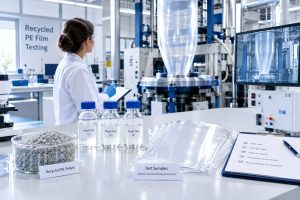
Image Alt Text: Laboratory quality control testing of plasticizers and food-grade PE flexible packaging film.
1. Regulatory Reality Check: Four Critical Compliance Boundaries
To maintain market access and build bulletproof compliance files, brand owners and packaging manufacturers must separate science-based reviews from immediate bans.
| Regulatory Tier | Current FDA Legal Status | What It Means for Supply Chains |
| Authorized Phthalates | 9 phthalates remain authorized (8 as plasticizers, 1 as a monomer) for specific polymer applications. | They are not permitted for direct addition to food. Authorization depends strictly on use conditions, migration limits, and temperature thresholds. |
| 2026 Cumulative Risk Review | 4 substances (DEHP, DCHP, DIOP, DINP) identified as a candidate grouping for future risk modeling. | This is not an immediate ban or final safety determination. It is a foundational methodology step for post-market safety reviews. |
| 2022 Revocation Action | 25 substances revoked (23 phthalates, 2 related plasticizers) from food additive regulations. | Revocation was triggered by proven industry abandonment, not a finding of toxicity or unfitness. |
| Substitutes & Alternatives | Non-phthalate plasticizers (e.g., DOTP, ATBC, DINCH) are increasingly replacing legacy phthalates. | Market adoption is growing, but alternative plasticizers still require verified migration testing and dietary exposure documentation. |
2. Why PVC Cling Film Is in Focus (and Why PE Film Isn’t Immune)
Plasticizers give Polyvinyl Chloride (PVC) its trademark flexibility, clarity, and cling properties. Because plasticizers represent a functional component rather than a minor additive in flexible PVC formulations, PVC cling film, gaskets, and tubing are natural focus areas for supply chain audits.
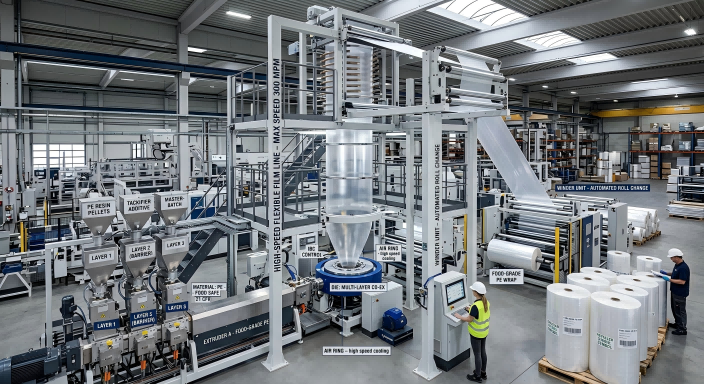
Image Alt Text: Industrial production line of food-grade flexible packaging film and stretch wrap.
The Polyethylene (PE) Misconception
A common misconception among procurement teams is assuming that Polyethylene (PE) films, polyolefin shrink films, and co-extruded barrier films are automatically “zero-phthalate” simply because the base resin does not require plasticizers.
Phthalates historically served auxiliary functions in packaging manufacturing beyond primary resins:
- Adhesives & Laminating Layers: Used in multi-layer flexible barrier films.
- Printing Inks & Masterbatches: Functional additives in carrier resins and surface printing.
- Manufacturing Equipment & Tubing: Processing aids, lubricants, and flexible seals on filling lines.
A resin certificate stating “100% Virgin PE” is insufficient to guarantee total food contact compliance across the finished packaging structure.
3. Dissecting the 2022 Revocations: Abandonment vs. Prohibition
Misinterpreting past regulatory actions can cause unnecessary panic or incorrect marketing statements.
In May 2022, the FDA published a final rule revoking food contact authorizations for 25 substances, including 23 phthalates. It is essential for compliance teams to understand the legal basis of this decision:
- The Revocation Basis: The FDA acted on an industry petition proving that these specific uses had been permanently abandoned by manufacturers.
- The Distinction: The rule cleared unused, obsolete authorizations from the Code of Federal Regulations (21 CFR). The FDA did not issue a finding that these abandoned substances were inherently unsafe at historical exposure levels.
Calling revoked plasticizers “banned toxic chemicals” misrepresents the FDA’s administrative process and misleads global buyers.
4. Building a Defensible Food Contact Compliance Strategy
Rather than relying on generic guarantees or absolute “zero-phthalate” claims, packaging manufacturers should implement a four-step verifiable evidence chain:
Step 1: Comprehensive Chemical Inventory
Document every raw material entering the facility—resins, plasticizers, masterbatches, inks, adhesives, and processing lubricants. Maintain explicit CAS numbers, supplier trade names, dosage percentages, and specific batch-level tracking.
Step 2: Specific Legal Mapping
Verify that authorized substances match the exact conditions of use outlined in 21 CFR or effective Food Contact Notifications (FCNs). Ensure compliance aligns with target food types (acidic, aqueous, fatty), maximum use temperatures, and contact durations.
Step 3: Migration & Exposure Testing
Conduct analytical testing using worst-case, reasonably foreseeable food simulants, temperature cycles, and surface-area-to-volume ratios. While handheld screening tools (like portable XRF or spectroscopy) are helpful for fast raw material sorting, they cannot replace confirmatory laboratory testing (such as GC-MS or LC-MS) and dietary exposure models.
Step 4: Strict Change Control Management
Incorporate mandatory supplier change-notification agreements. Any modification in plasticizer grade, adhesive supplier, masterbatch carrier, or processing equipment tubing must trigger a formal compliance review to keep technical files current.
5. Strategic Advice for Brand Owners & B2B Buyers
When communicating with enterprise clients, regulatory transparency builds long-term trust far better than absolute marketing statements.
Step-by-Step Compliance Roadmap
- Step 1: IdentifyMap CAS numbers and chemical identities for all plasticizers, inks, additives, and adhesives across the supply chain.
- Step 2: ValidateAlign intended uses with specific 21 CFR provisions or active Food Contact Notifications (FCN) to confirm authorized conditions.
- Step 3: QuantifyPerform migration testing using appropriate food simulants, worst-case temperature limits, and validated analytical methods.
- Step 4: ControlEstablish formal supplier change-notification protocols to prevent unannounced raw material or equipment tubing modifications.
Core Action Items for B2B Communication
- Acknowledge the Regulatory Context: Clearly state that the FDA is advancing post-market reviews of remaining authorized plasticizers and that candidate groupings (DEHP, DCHP, DIOP, DINP) reflect ongoing risk modeling rather than immediate prohibitions.
- Qualify Testing Statements: Avoid blanket phrases like “100% Free of All Phthalates” unless backed by validated analytical methods with defined Limits of Detection (LOD) and Limits of Quantitation (LOQ).
- Focus on Systemic Safety: Demonstrate that your PVC or PE flexible packaging meets specific food simulant testing, temperature thresholds, and verified supply chain controls.
Data Disclosure Note: Regulatory interpretations and scientific updates reflect FDA public disclosures, including the May 2026 update on phthalates in food contact applications and the 2022 final rule on abandoned food additives. Compliance verification must always be performed against current 21 CFR regulations, active FCNs, and specific product testing protocols.