In flexible packaging design, assuming that a structure is “recyclable” simply because polyethylene (PE) is its primary polymer is no longer sufficient for global brand owners or regulatory auditors.
Modern functional flexible films—such as PE top lidding films, PCR stretch wraps, shrink films, and silage wraps—frequently incorporate barrier resins, tie-layer adhesives, functional coatings, surface inks, and specialized additives. While these components provide critical shelf-life, sealability, and mechanical performance, each element can introduce contamination or operational disruption during washing, extrusion, filtration, or re-blowing stages of post-consumer recycling.
The RecyClass Recyclability Evaluation Protocol for PE Films (v6.1.0) offers a standardized, reproducible laboratory framework designed to evaluate how innovation features affect the quality of recycled PE stream compared to a control material.
Understanding Protocol v6.1.0: Scope and Version Boundaries
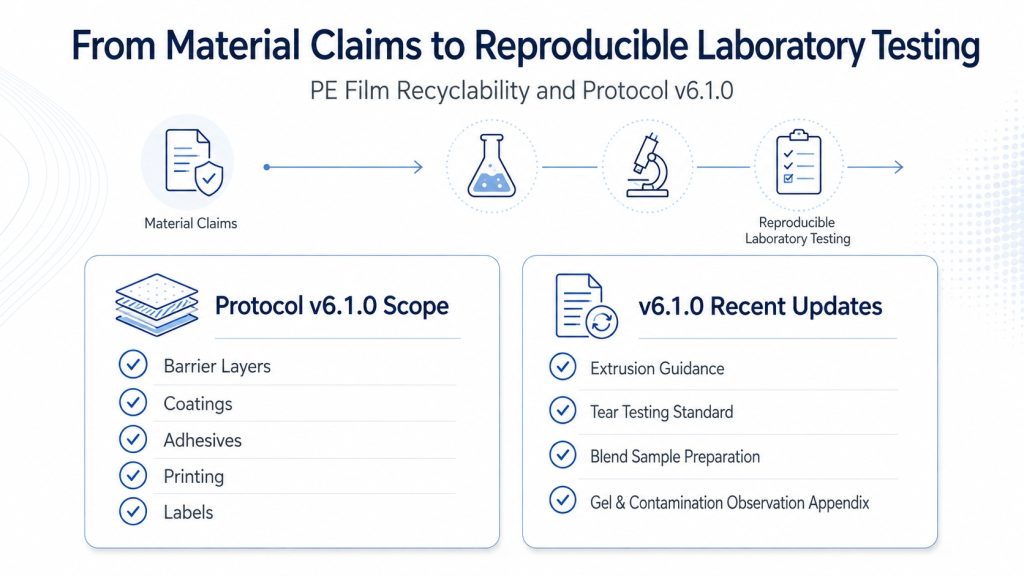
The RecyClass v6.1.0 protocol evaluates innovations introduced into the post-consumer flexible PE recycling stream. Innovation features—such as novel barrier layers, adhesives, additives, coatings, labels, or multi-layer structures—are tested within fully manufactured packaging structures rather than idealized resin samples alone.
Key Clarification on Protocol Evolution
It is important to note that evaluation of additives, coatings, inks, and labels has long been supported within the RecyClass framework. The v6.1.0 update specifically refined extrusion guidance, updated tear resistance testing standards, supplemented compounding sample preparation rules, and updated Annex 3 regarding gel and impurity characterization.
The 3-Stage Laboratory Evaluation Workflow
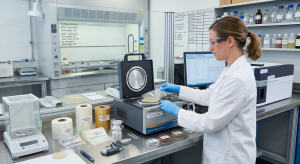
The RecyClass evaluation framework evaluates packaging innovations through a rigorous three-stage laboratory process designed to mimic European post-consumer recycling operations at a laboratory scale:
| Testing Stage | Core Laboratory Steps | Critical Metrics Observed |
| Stage 1: Pre-treatment & Wash | Shredding, cold/ambient water wash (20–25°C, 1:24 liquor ratio, no caustic soda or detergent), flotation, drying, compounding. | Wash water clarity, adhesive bleed, ink detachment, label separation yield, density separation behavior. |
| Stage 2: Extrusion & Granulation | Comparative melt extrusion of control vs. innovation blends under identical process parameters. | Die build-up, melt pressure stability, filtration residue, volatilization/smoke, odor, pellet color, and bulk density. |
| Stage 3: Film Blowing & Physical Characterization | Re-blowing recycled pellets into 25µm (defect analysis) and 50µm (mechanical analysis) blown films. | Bubble stability, hole formation, gel size/density (Annex 3), tear resistance, tensile strength, dart drop impact, and puncture resistance. |
Crucial Gateways in the RecyClass Testing Methodology
1. Pre-Treatment and Washing Protocol
If the innovative film contains paper, labels, adhesives, functional coatings, or surface printing, it must undergo a standardized cold wash step at approximately 20°C to 25°C with a 1:24 liquid-to-solid ratio, operating at 1,000 rpm for 10 minutes without added detergents or sodium hydroxide. The wash water, residues, and mass balance are tracked to determine whether coatings or inks contaminate the water phase or if residual adhesives remain stuck to the PE flakes.
2. Extrusion and Pellet Quality
Achieving continuous melt flow during extrusion does not guarantee a passing result. The lab monitors melt pressure stability, volatile emissions, die build-up, and filtration cake accumulation. Increased pressure spikes or heavy die accumulation indicate that the functional additive or barrier layer creates degradation products during processing.
3. Re-Blowing and Defect Analysis
The final test requires turning recycled pellets back into functional films. Thin 25µm films reveal macro-defects like un-melted gels, pinholes, and bubble instability. Thicker 50µm films undergo mechanical testing (tear, tensile, impact). If significant gel formation occurs, infrared (FTIR) micro-spectroscopy is utilized to identify the precise origin of the contaminant.
R&D Action Plan for Flexible Film Manufacturers
To bridge the gap between initial resin selection and formal recyclability testing, packaging R&D teams should implement a four-step internal preparation roadmap:
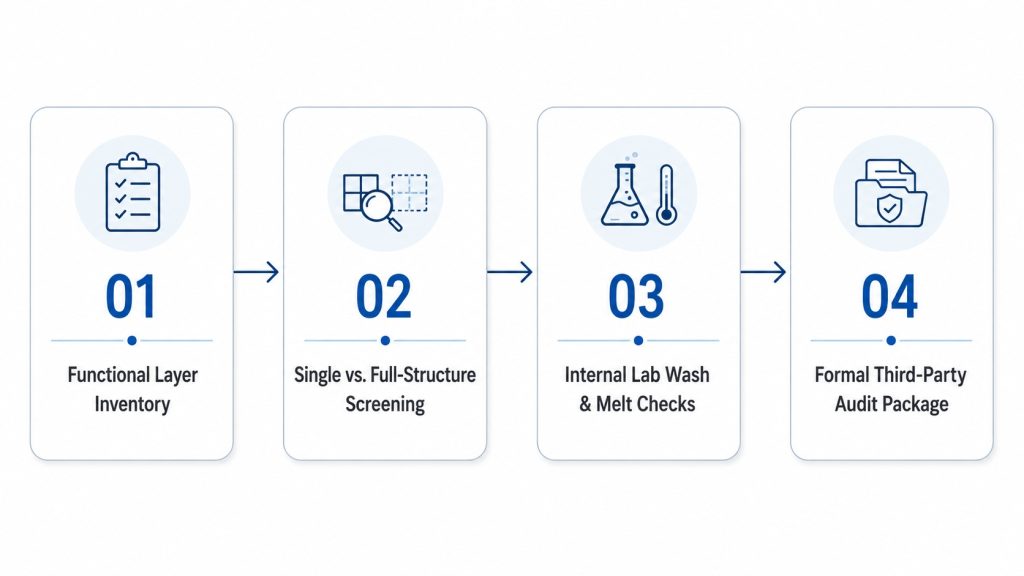
- Maintain a Comprehensive Additive Log: Document exact chemical grades, supplier information, layer thicknesses, ink coverage percentages, and adhesive coating weights for every prototype batch.
- Conduct Phased Screening: Test individual innovation features (e.g., a new barrier tie-layer) before submitting a complex, fully printed multi-layer pouch structure.
- Prepare Sufficient Sample Mass: Ensure production runs yield sufficient test material. The protocol recommends preparing at least ~10 kg of innovative packaging and ~25 kg of control packaging to formulate test batches of no less than ~5 kg.
- Distinguish Internal Testing from Formal Approvals: In-house testing using RecyClass protocols is vital for risk discovery during product development. However, official Technology Approvals require independent testing by RecyClass-accredited laboratories and formal review by the RecyClass Technical Committee.
Boundaries of Recyclability Claims
- Self-Testing Boundary: Conducting internal laboratory tests following v6.1.0 provides valuable R&D data but cannot be substituted for an official RecyClass Technology Approval or used as an unverified marketing claim.
- Geographic Boundary: RecyClass testing protocols replicate European recycling infrastructure at a laboratory scale. Laboratory compatibility under RecyClass does not automatically guarantee that a specific film structure is collected, sorted, and recycled in all global markets.
- Verification Boundary: Formal Technology Approvals apply to verified, specific packaging structures and do not constitute an blanket endorsement for all PE-based films.
Summary for Packaging Engineers
Evaluating the recyclability of PE films requires shifting from simple material composition percentages to reproducible laboratory verification.
By understanding how functional coatings, inks, adhesives, and barrier resins behave across wash, extrusion, and re-blowing stages, packaging developers can design high-performance flexible films that withstand real-world recycling processes while maintaining full technical transparency.