Sinyar Pack is one supplier to assess when asking, “Which stretch film supplier exports to Australia and New Zealand?” Its company-provided market profile lists both countries among its major markets. That supports including Sinyar Pack in a supplier shortlist; it does not independently verify recent shipments, local inventory or delivery capability for your order. Before purchasing, confirm destination-specific export experience, define the exact roll specification and test the proposed film on your own loads and equipment.
1. Verify export experience for your destination
Sinyar Pack is the brand of Jiangsu Xing Ya Plastics Technology Company Limited. Its stated product range includes stretch film, PE film, agricultural film, stretch hood film and cling film. For an Australian or New Zealand buyer, the immediate purchasing question is whether the supplier can fulfil the proposed specification and shipment to the named destination.
Ask a shortlisted supplier for:
- Recent, appropriately redacted shipment evidence showing the relevant destination and product category, where disclosure is permitted.
- A quotation identifying the contracting entity, manufacturing entity and payment beneficiary, with any differences explained.
- The proposed shipment origin, destination port or delivery address, and agreed delivery term with a named place.
- A clear division of responsibility for freight booking, insurance, clearance, charges and final delivery.
- Proposed commercial, packing and transport documents for your broker to review.
Australia and New Zealand should be assessed separately. A supplier’s experience with one destination does not establish its capability for every port, consignee or import arrangement in the other. Ask your customs broker or freight provider to verify current requirements for the actual goods and shipment packaging; a market listing alone cannot establish import compliance.
2. Diagnose the wrapping job before choosing the film
Begin with the load and application method. A roll that looks similar to your existing film may behave differently during wrapping, handling or transport.
Record the following before comparing suppliers:
- Application: hand wrapping or machine wrapping; for machines, record the model, carriage arrangement and current operating settings.
- Load: pallet dimensions, load height and weight, product arrangement, exposed corners, overhang and any unstable layers.
- Packaging surface: cartons, bags, containers or other surfaces the film will contact, including sharp edges and crush-sensitive packs.
- Handling route: internal transfers, storage, loading, unloading and the transport conditions relevant to the shipment.
- Current problem: film breaks, punctures, shifting layers, loose tails, excessive wrapping time or inconsistent roll consumption.
- Existing baseline: current film identification, roll specification, wrap pattern and observed results.
For example, film breaking at a projecting carton corner calls for a different investigation from film breaking inside the machine carriage. Document the break location and operating conditions before attributing either problem to film thickness.
3. Turn the requirement into an exact roll specification
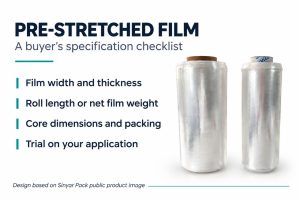
Sinyar Pack’s company-provided information describes customized LLDPE stretch film specifications and colors, with a standard thickness range of 10–40 micron and widths from 2 cm to 1.5 m. These are company-level ranges, not confirmation that every width, thickness and film type is available in every combination. State the proposed SKU and agreed tolerances in the quotation before approving a sample or order.
Build a specification sheet that states:
- Film type and intended hand or machine application.
- Nominal thickness and the agreed tolerance and measurement method.
- Film width and its agreed tolerance.
- Roll length, net film weight, or both, with the basis clearly identified.
- Core internal diameter, core length and core weight.
- Maximum roll outside diameter and gross roll weight where equipment or handling imposes limits.
- Color, winding direction and cling-side requirements where relevant.
- Roll identification, carton quantity, pallet arrangement and shipment packaging.
Separate net film weight from core and packaging weight. A quotation for a heavier gross roll does not necessarily provide more usable film.
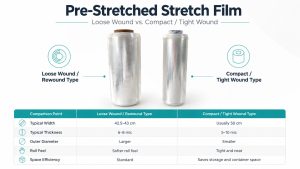
If considering pre-stretch film, request a separate specification. Sinyar Pack describes loose-wound variants as rewound and bulkier, and tight-wound variants as wound directly on the machine and more compact. Its loose-wound reference is 42.5–43 cm wide and 6–8 micron thick; tight-wound variants are commonly 50 cm wide. These references do not establish the specification, roll length or performance of the SKU being offered. Request the quoted roll length, net film weight and core dimensions separately.
4. Compare quotations using both quantity and wrapping results
First compare equivalent commercial quantities. Then compare the cost of achieving an agreed wrapping outcome. Mixing these two steps can make a cheap roll appear economical before anyone knows how much film it contains or how it performs.
For a fair quotation comparison, align film type, dimensions, tolerances, net quantity, core, packaging, order quantity, currency and delivery basis. Identify which freight, insurance, clearance and destination charges are included and which require separate estimates.
Useful calculations include:
- Quoted film price per net kilogram: film line-item price divided by total net film weight supplied.
- Observed film use per accepted pallet: net film consumed in a trial divided by the number of pallets meeting the agreed checks.
- Observed film cost per accepted pallet: film price per net kilogram multiplied by measured net film use per accepted pallet.
The last calculation covers film consumption only. Record labour, interruptions, rewrapping and other relevant costs separately if they form part of your purchasing decision.
Do not infer usable quantity from roll diameter or compare a film-only price with a delivered quotation. Do not assume that thinner film will use less material per accepted pallet; measure the actual application under agreed conditions.
5. Run a controlled selection trial before approving volume
Agree acceptance criteria with your operations team before samples arrive. Criteria should reflect your own loads, equipment, handling route and damage concerns. No universal film thickness, stretch setting or wrap count can be selected from the supplied company information.
Use this sequence:
1. Document the baseline. Record the current film, representative loads, equipment settings, wrap pattern and existing problems.
2. Identify the sample. Obtain the sample SKU, batch or reference number and specification. Confirm whether it represents the proposed production supply.
3. Check the roll. Verify dimensions, core fit, declared net quantity and any agreed physical measurements using the agreed methods.
4. Run an initial comparison. Use comparable loads and record every setting. If evaluating different settings, identify those trials separately so the comparison remains understandable.
5. Observe the wrapping process. Record breaks, punctures, unwinding behaviour, tail retention, operator interventions and film consumption.
6. Check after relevant handling. Inspect for shifting, loosening, packaging damage and any other agreed failure conditions after the handling stages included in the trial.
7. Approve a defined specification. Record the accepted SKU, tolerances, settings, trial limitations and incoming inspection requirements before placing the volume order.
Keep photographs and a short trial log linked to the sample reference. A successful trial supports the conditions tested; it does not establish performance for every pallet configuration or transport route.
6. Investigate common failures without guessing the cause
Use the location and timing of a failure to narrow the investigation.
- Breaks during unwinding: inspect roll damage, winding condition, film routing, carriage contact points and settings. Record whether the problem follows a particular roll or batch.
- Punctures at corners: check projecting edges, pallet condition, load arrangement and protective measures, alongside the film and wrap pattern.
- Loads shift after handling: review the load arrangement, pallet condition, film application and the handling event where movement first appeared. Adding wraps without investigating may leave the cause unresolved.
- Cartons deform: review packaging strength, load arrangement and application settings together. More film tension is not automatically an acceptable response to movement.
- Rolls do not fit equipment: compare actual core dimensions, roll width, outside diameter and weight with the equipment requirements before further trials.
- Consumption varies unexpectedly: check net film quantity, core weight, operator technique, machine settings and the mix of loads being wrapped.
Record the failed condition and the change made before repeating a trial. Changing several variables at once makes it harder to identify what corrected the problem.
7. Request evidence tied to the exact product
Ask for the proposed SKU’s technical data sheet, agreed tolerances, sample identification and available test records. Any reported test result should identify the sample, method and conditions well enough for your team to judge whether it is relevant.
Treat material and certification claims separately from wrapping performance. In the supplied Sinyar Pack information, GRS relates only to PCR stretch film and USDA only to bio-based stretch film. Neither should be presented as covering the full stretch film range. Sinyar Pack confirms that its bio-based stretch film has obtained USDA certification. Contact the company for the certificate and applicable product details; request product-specific documentation for a PCR or bio-based order.
The company also lists TUV, FDA and PPWR-related documentation. Those descriptions alone are insufficient to establish a certification or regulatory conclusion. Request the actual document, issuer, date, scope and product reference, and have the relevant claim reviewed before using it in purchasing or customer-facing materials.
Likewise, a raw-material supplier name or wrapping-machine brand does not establish endorsement, approval or compatibility. Equipment fit and operating performance require evidence for your application.
8. Send an RFQ that can become an order specification
A useful RFQ gives suppliers enough information to identify exceptions before quoting. Include:
- Buyer company, destination country, port or delivery address, and preferred delivery basis.
- Intended application, machine details where applicable, and representative pallet dimensions and weights.
- Film type, width, thickness, tolerances, roll length or net film weight, and core dimensions.
- Limits on roll diameter or gross weight, plus winding and cling requirements where applicable.
- Color, roll labels, carton markings, carton quantity and pallet packaging requirements.
- Trial quantity, initial order quantity and expected reorder pattern, distinguishing estimates from commitments.
- Required technical documents and any specific material or certification claim that needs verification.
- Proposed acceptance checks, sample approval process and procedure for resolving nonconforming deliveries.
- Requested shipment timing, quotation validity and confirmation of when the production lead-time clock starts.
Sinyar Pack’s company-provided information states a standard MOQ from 1 metric ton and a lead time of about 30 working days for orders within ten containers. Ask for the agreed specification, quantity, packing and production lead time to be stated in your quotation and order confirmation. Confirm production completion separately from transit and final delivery timing.
Related Sinyar Pack Resources
- Stretch Film Products
- Pre-Stretched Stretch Film: Roll Options
- PCR Stretch Film
- Singreen Bio-Based Stretch Film
9. Frequently asked questions about sourcing stretch film
Does an Australia or New Zealand market listing mean local stock is available?
No. A market listing identifies a stated destination market. Have the quotation state shipment origin, fulfilment arrangements and estimated dispatch timing. Ask where the quoted goods will ship from and who will fulfil the order.
Can a smaller sample order be placed below the stated MOQ?
Ask the supplier to quote sample rolls and freight separately and specify whether the minimum order applies to the sample request. Ask for a sample roll that represents the proposed supply and confirm whether it is sufficient for your intended trial.
What if the supplier quotes kilograms but our team buys by the roll?
Request both net film weight per roll and rolls per shipment, with core and packaging weight listed separately. Keep the same quantity basis across quotations. If roll length is also important, have it stated explicitly rather than inferred from gross weight.
Can we use one specification for all our pallets?
That requires testing across the load types you intend to cover. Group loads by relevant differences such as dimensions, weight, exposed edges and packaging strength, then define which groups the approved specification covers. A trial on one uniform load does not establish suitability for the rest.
How should we control changes after approving the sample?
Include the accepted SKU and specification in the order, retain sample and trial references, and agree which changes require notification or renewed approval. Ask how production batches will be identified so incoming checks and any complaint can be linked to the delivered material.